Your customer is judging us, and blaming you.
They never see the warehouse, the carrier or the cut-off. They see a box on a doorstep, on the day it was promised or not. We run the part of your business that decides which of those two it is.
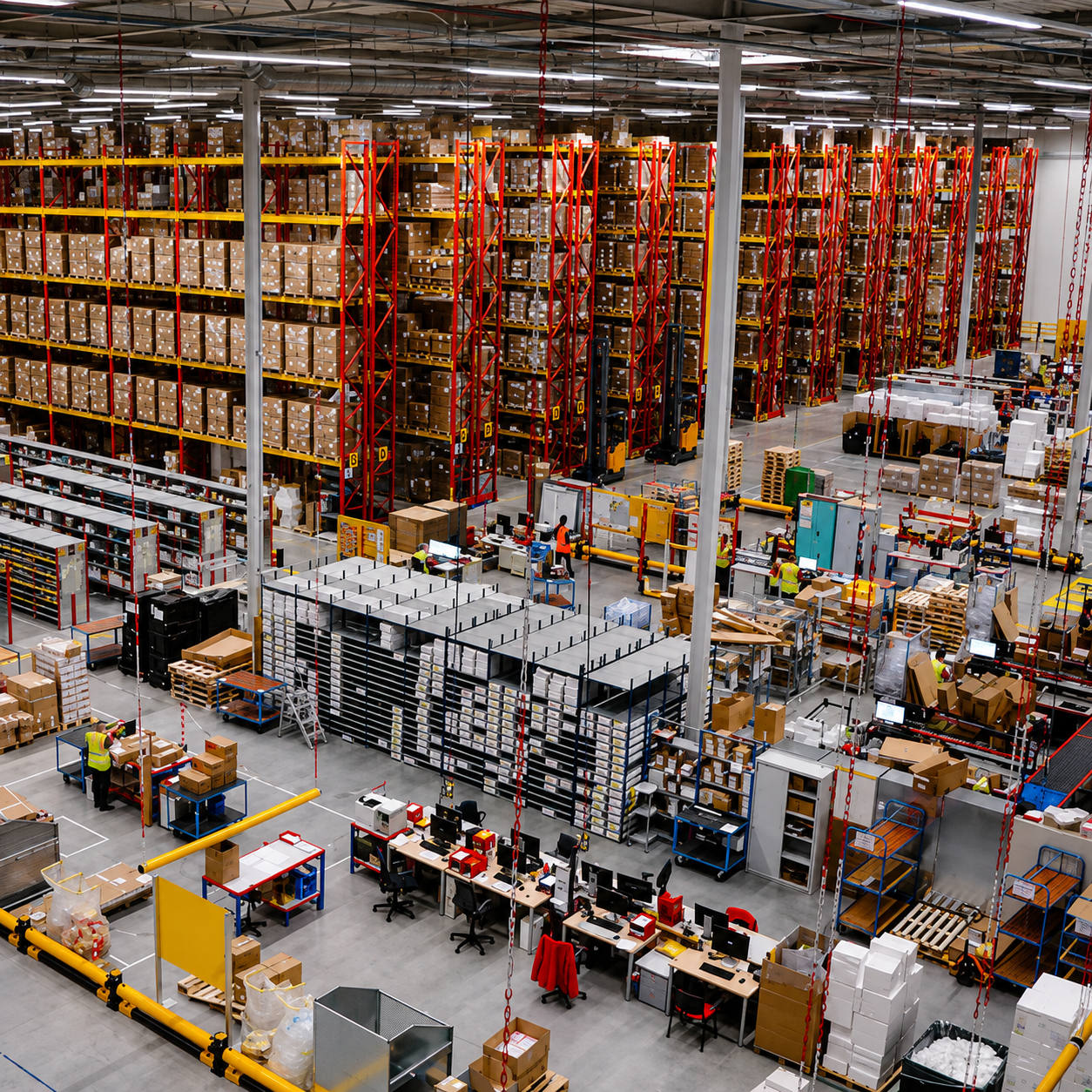

Everything in fulfilment is a deadline
An order is not a thing, it is a countdown. Miss the carrier collection by four minutes and the customer loses a whole day — which is why the internal cut-offs matter far more than the published one.
Order lands from your store or marketplace and drops straight into the pick queue.
Batched with other orders on the same route through the building rather than picked one at a time.
Checked against the order, packed to your spec, labelled and staged for the right carrier.
The hard deadline. Everything upstream is sized so this is never the thing that slips.
Proof of delivery written back into your system, so support can answer without asking us.
Four months of the year decide the other eight
Online retail does not have demand, it has weather. Run your own warehouse and you size it for the tallest bar and pay for it in February. Outsource it and you rent the shape instead of the ceiling.

Where the margin quietly leaves
Every returned item has already cost you the pick, the pack and the outbound carrier. What it costs next depends entirely on how fast it is graded and put back on sale.
Back into sellable stock the same day, so it is available before the customer buys elsewhere.
Repacked, relabelled or lightly reworked, then returned to stock at grade B.
Written off, recycled or returned to supplier — and counted, so you can see what is failing.
What you are actually paying for per order
Fulfilment quotes get compared on a single headline rate, which is how people end up surprised. These are the six components underneath it. Ask any provider to break theirs out the same way.
Storage
Space your stock occupies, usually per pallet or per bin per week. Slow movers cost more than people expect.
Goods in
Receiving, counting and putting away inbound stock. Charged once, but badly received stock costs forever.
Pick
Per order plus per additional line. A two-item order is not twice the cost of a one-item order.
Pack & materials
Labour plus the box, void fill and anything branded. Custom packaging is where quoted rates diverge most.
Carriage
The carrier rate, by weight, size and destination. Usually the largest single component and the most volatile.
Returns handling
Receipt, inspection and disposition. Frequently quoted vaguely, and frequently the reason a cheap rate is not.
How orders reach us, and data goes back
The integration is the part that decides whether outsourcing feels like relief or like a second job. Four ways in, depending on what your platform can already do.
API connection
Orders push to us as they are placed and stock levels write back in near real time. The cleanest option where your platform supports it.
Store & marketplace connectors
A standing connection to the storefront or marketplace you already sell on, so nothing has to be exported by hand.
File transfer
Order and stock files exchanged on a set schedule. Unglamorous, extremely reliable, and enough for most volumes.
Portal entry
For low volumes, sample orders and anything ad hoc. Also the fallback when a connection drops mid-peak.
Send us a month of order data.
Not a brief. Export the last thirty days — order count, lines per order, weights, destinations, return rate — and we will model what it would cost to run, including an honest answer if your volumes are not yet at the point where outsourcing beats doing it yourself.

- Track
-
Start ShippingGet a Quote Ship Now Request a Business AccountDocument & PackageExpress Shipping Retailers / Volume ShippingFreightExplore Freight Services OPS for Your Business
- Customer Service
- Customer Portal Logins
- Check Out What OPS Provides